
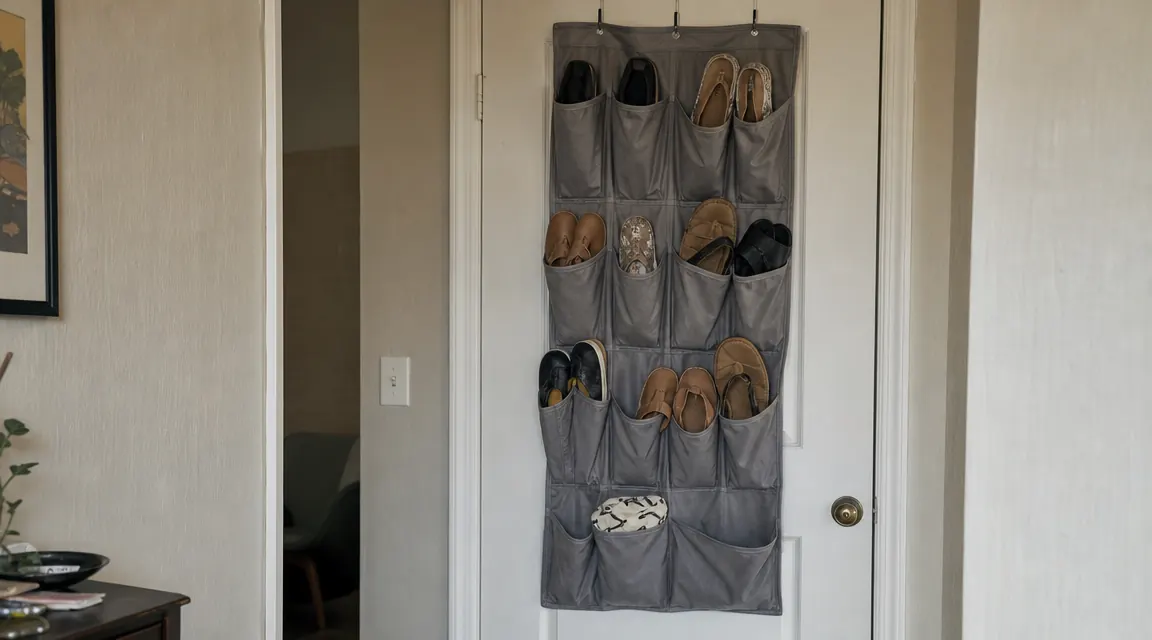
There are 32,426 ratings on the Amazon Basics 24-pocket over-door shoe organizer as of this writing. That is enough to drown out almost any specific concern. The aggregate score lands at 4.6 stars and the complaints about poor quality get outvoted by the happy majority who hung it on the right door with the right size shoes. But the unhappy minority has a point, and their grievances are usually one of three things: wrong door type, wrong shoe size, or wrong expectations from the listing photos. None of those three failure modes show up in the summary ratings. That is what this review covers.
I have used this organizer myself and tested the specific measurements and door scenarios that trip people up. This is not a summary of the five-star reviews. It is the review I would want to read before clicking buy.
The Quick Verdict
Genuinely useful for renters with small-to-medium shoes and a hollow-core interior door, but the listing photos and pocket count both mislead buyers who wear large shoes or live with a mixed-size household.
Amazon Check Today's Price →Know the fit before you buy: this budget organizer fixes a real problem when the door is right.
The Amazon Basics 24-pocket shoe organizer is one of the most practical entryway fixes available for renters. If your door is a standard hollow-core interior door and your shoe sizes run women's 6 through men's 10, it works exactly as described.
Amazon Check Today's Price on Amazon →The Listing Photos Are Misleading in One Specific Way
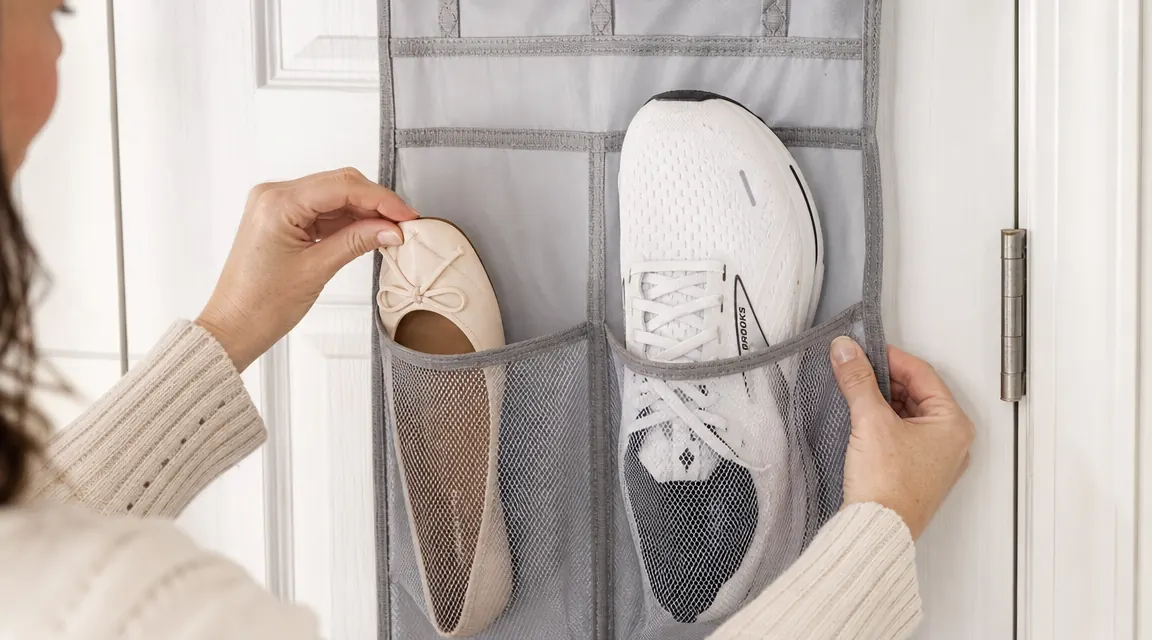
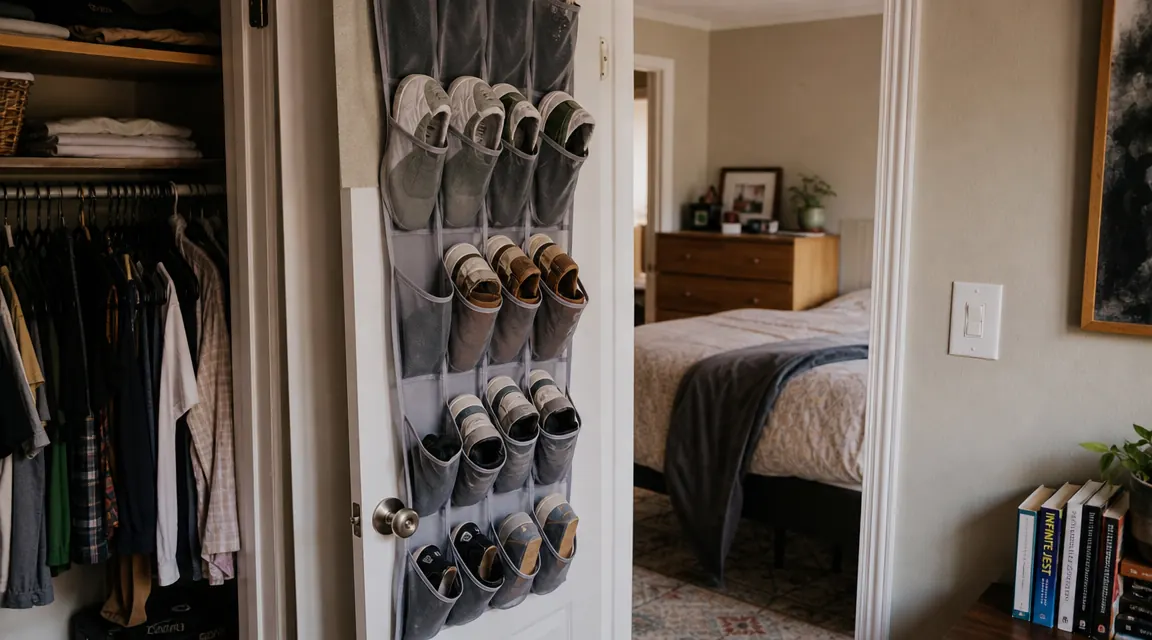
Look at the Amazon listing photos for this organizer. Every shoe shown is a women's flat, a small sandal, or a child's sneaker. These styles sit completely inside the 4.5-inch-deep pockets with room to spare, which makes the pockets look tidy and full. They are photographed from a slight distance so the proportions look generous. What the photos do not show is what happens when you put a normal women's size 9 athletic sneaker in there, or a men's casual shoe of any size. The heel extends above the pocket top. The shoe does not fall out, but it hangs there at an angle, which looks nothing like the product photos.
This is not fraud. The organizer does hold those shoes. But the visual expectation the listing sets does not match the visual reality for the majority of adult shoe sizes. If you buy this expecting it to look like the photos, you will be disappointed. If you buy it knowing your larger shoes will sit with heels sticking out by 1 to 2 inches, you can decide whether that bothers you or not. For me it does not, because the shoe is still secured and off the floor. For some people the aesthetic matters.
The Pocket Math for a Two-Adult Household
Twenty-four pockets sounds like a lot until you run the numbers for a real household. One pocket per shoe is the only method that works reliably. Stuffing two shoes in one pocket only functions for flat sandals and thin flip-flops because anything thicker than about 0.75 inches causes the mesh to stretch and the shoes slide out when the door moves. So you have 24 usable slots.
In a household with two adults who each have 10 regularly worn pairs, you need 20 pockets for those shoes alone. That leaves 4 pockets. If either person has a pair of rain boots or bulky sneakers that do not fit the pockets at all, your effective total drops below 24 real slots. A single person with 12 to 15 pairs of varied shoes will fill this organizer with ease and have it at capacity within a month. The 24-pocket count is the right size for one person or a couple where one person has very few shoes. It is not a high-capacity solution.
The listing says 24 pockets and the buyer reads 24 pairs. Both are technically true. The reality of mixed shoe sizes and couple usage patterns means most two-adult homes will hit functional capacity before they hit the mathematical limit.
Door Compatibility: The Full Breakdown by Apartment Type
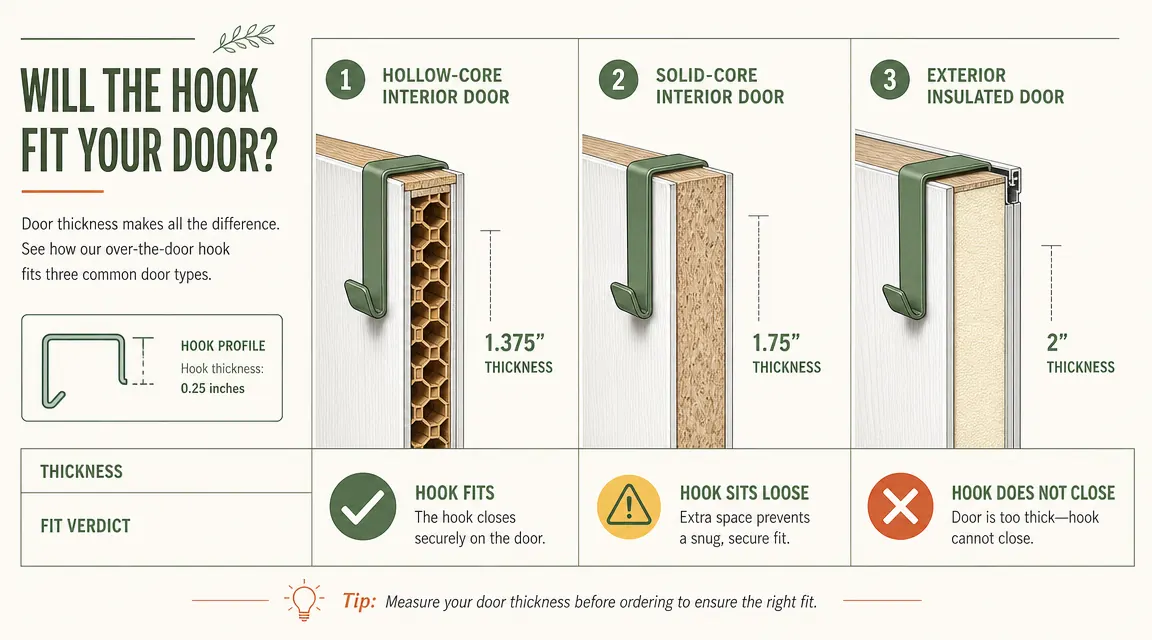
The hook gap on this organizer is designed for hollow-core interior doors with a door thickness between 1.25 and 1.5 inches. That covers the majority of interior doors in apartments built before about 2010. It is the standard size for bedroom doors, bathroom doors, closet doors, and in older garden-style apartment buildings, often the front unit door as well. If you have one of these doors available, the hooks work exactly as designed: they slide over the top edge, the J-curve rests on the front face, and the back rod contacts the door behind without play or rocking.
Solid-core interior doors, which are increasingly common in newer apartment construction, typically run 1.625 to 1.75 inches thick. The hook gap on this organizer does not close completely around those doors. The organizer hangs, but there is a small gap between the rear rod and the door face. This means the organizer sits slightly angled outward and rocks gently when the door opens or closes. It will not fall, but the motion is noticeable and annoying, and over time the rocking can leave a wear mark on the door frame. I do not recommend this organizer on solid-core doors without replacement hooks.
Exterior doors, fire-rated apartment doors, and metal security doors in high-rise buildings typically run 1.75 to 2 inches or more. These doors are completely incompatible with the standard hooks. The hooks will sit on top of the door but the organizer will tilt outward at an angle of roughly 15 to 20 degrees and the whole thing will feel unstable. This is the scenario that generates the angry one-star reviews about the organizer falling and spilling shoes everywhere. It is not a product defect. It is a door mismatch, but the listing does not call this out clearly enough.
The hook gap fits hollow-core doors between 1.25 and 1.5 inches. That covers most pre-2010 apartment interior doors. Newer solid-core doors and all exterior doors require wider replacement hooks or a different placement entirely.
What Happens to the Grey Mesh Over Time
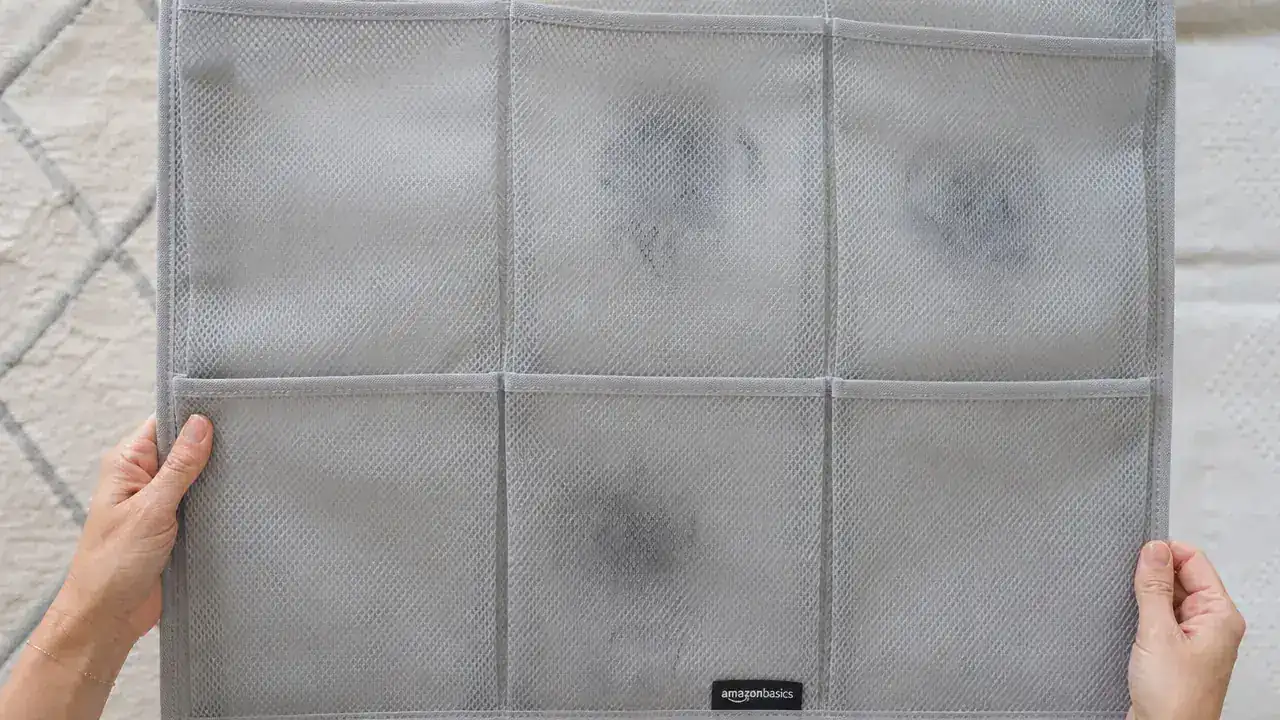
The light grey color of this organizer is aesthetically versatile and practically problematic over time. Dark-soled shoes leave rubber scuff marks on the grey mesh that are visible at normal viewing distance. This begins within the first two to three months of use, faster if you have dark rubber-soled athletic shoes or boots. The scuffing does not affect the structural integrity of the mesh at all. The pockets continue to hold shoes without issue. But the organizer starts to look dirty in a way that is impossible to fully clean.
Hand-washing the mesh with a damp cloth removes surface dust but does not eliminate rubber transfer stains. A mild detergent and a soft brush will reduce them, but not remove them entirely. The darker grey tones the scuffs create blend in better after a few months because the whole organizer gradually evens out to a medium grey. If you are buying this for a visible entryway where aesthetics matter to you, budget for replacing it at the 18-month mark. If it is going inside a closet where nobody but you sees it, the scuffing is irrelevant.
The structural mesh itself holds up well. The polyester weave does not fray or tear under normal load. After more than a year of daily use, high-use pockets stretch slightly, meaning the shoe sits 0.25 to 0.5 inches lower than it did originally. This is cosmetic, not functional. The pocket still holds the shoe securely.
What Nobody Reviews: The Sound When the Door Opens
When you hang this organizer on a door and open that door, the organizer swings with it and the shoes inside jostle. This creates a light rustling and clacking noise from the shoes shifting against each other in the mesh pockets. For most apartments this is a non-issue. Nobody cares that their entryway door makes a soft shuffle sound when they open it. But in two specific situations this matters more than you would expect.
The first is if you hang it on a bedroom door and you or your partner comes in late at night. The second is if the door you hang it on is a closet door that gets opened multiple times a day in a shared bedroom. The noise is not loud. It is more of a muffled clatter than a clang. But it is consistent, and once you notice it you notice it every time. If your apartment has thin walls or a light-sleeping household member, test this before committing to a bedroom door placement. A closet at the far end of the apartment is a better location for noise-sensitive situations.
The Weight Distribution Problem With Heavier Shoes
The organizer has no reinforced bottom pockets. All 24 pockets use the same mesh weight. The top 12 pockets are supported more directly by the backing and the hooks. The bottom 12 pockets hang freely below, supported only by the backing strip. When those bottom pockets are loaded with heavier items, ankle boots being the most common offender, the organizer sags forward at the bottom. The hooks remain in place on the door, but the bottom third of the organizer pulls away from the door surface by 2 to 3 inches.
This sagging is primarily a visual issue when the door is closed. It becomes a practical issue when the door opens because the sagging bottom section swings with more momentum and the shoes have a higher chance of jostling loose. If you plan to use the bottom pockets for heavier shoes, women's boots or men's casual shoes in the size range that almost fits, load the heaviest items in the middle rows where the backing provides more support, and keep lighter items like sandals and flats in the bottom rows.
What I Liked
- At current pricing it is the lowest-cost per-pocket shoe storage solution available for renters with no-drill requirements
- Compatible with hollow-core interior doors found in most pre-2010 apartments with zero tools needed
- 24 pockets is the right capacity for a single person or a couple where one person has under 10 pairs
- Mesh visibility lets you scan the whole collection at a glance, which genuinely speeds up the morning shoe grab
- Folds completely flat for moving, takes under five minutes to rehang in a new apartment
- Works for non-shoe storage in bottom rows: cleaning supplies, small accessories, reusable bags, gloves
Where It Falls Short
- Listing photos use only small women's shoes, creating an inaccurate visual expectation for buyers with larger feet
- Hook gap is incompatible with solid-core and exterior doors without purchasing wider replacement hooks separately
- Light grey mesh shows dark rubber sole scuff marks within two to three months of regular use
- No reinforced bottom pockets, causing sag and forward-lean when lower pockets hold ankle boots or heavier shoes
- Twenty-four pockets fills faster than expected in a two-adult household where both people have varied footwear
- Shoes in low pockets clatter against each other when the door opens, which matters on bedroom and closet doors
The Replacement Hooks Fix That Nobody Talks About
If your apartment door is the wrong thickness for the standard hooks, the fix is not to return the organizer. Wide-gap over-door hooks sized for 1.5 to 2-inch doors are available on Amazon inexpensively for a pair. They use the same grommet slots on the organizer backing. You swap out the included hooks, slide in the wider ones, and the organizer hangs cleanly on doors up to 2 inches thick. This is not a documented feature of the Amazon Basics organizer. You will not find it mentioned anywhere in the listing. But it is the actual solution to the single most-complained-about failure mode this product has.
If you are buying this for an apartment where you are not sure of the door thickness, measure the door edge before ordering. A standard tape measure works fine. Hollow-core interior doors measure 1.375 inches. Solid-core interior doors typically measure between 1.625 and 1.75 inches. Any measurement above 1.5 inches means you should order replacement hooks at the same time as the organizer so you have them ready at installation.
Who This Is For
The Amazon Basics 24-pocket shoe organizer is the right choice if you are a renter in a pre-2010 apartment with hollow-core interior doors, your shoe collection runs primarily women's sizes 6 through 9 or men's sandals and dress shoes up to about a size 10, and your main problem is floor clutter rather than storage volume. At current pricing it is a no-risk purchase for that specific situation. The cleared floor space in a small apartment entryway or studio is a real, daily quality-of-life improvement.
Who Should Skip It
Skip this if your only available door is a solid-core or exterior door and you do not want to buy replacement hooks. Skip it if your household wears primarily men's shoes in size 11 or larger, because the 4.5-inch pocket depth will frustrate you every time. Skip it if you need to store more than 20 varied pairs between two adults, because you will hit functional capacity before you expect to. And skip it if you are putting it on a bedroom door in a household with a light sleeper, because the shoe shuffle noise when the door opens will get old fast. For all of those situations, a hanging shelf organizer with open shelves or a freestanding shoe cabinet handles the job better. The over-door format with the hanging shelf style is covered in more detail in the comparison article linked below.
Right door, right shoe size, right household size: this budget organizer delivers every time.
Once you know the door-thickness and pocket-depth limits, the Amazon Basics shoe organizer is a genuinely useful renter's tool. Check current pricing and availability before your next entryway project.
Amazon Check Today's Price on Amazon →